
Clare Josa's Imposter Syndrome Iceberg is a coaching model that helps us to understand why mindset, thought-based interventions aren't enough to clear Imposter Syndrome.
The Imposter Syndrome Iceberg is derived from her 2018 Imposter Syndrome research study, published in 2019, and was first published in her 2019 book, Ditching Imposter Syndrome. The model explores the symptoms vs causes of Imposter Syndrome, explaining why so many people incorrectly conclude that it's 'incurable' and just something you have to put up with.
The Imposter Syndrome Iceberg can help people to release the guilt and shame that so often accompanies Imposter Syndrome, supporting them to access the deeper strategies that allow them to set themselves free from this, once and for all.
Read on to explore this model in detail.
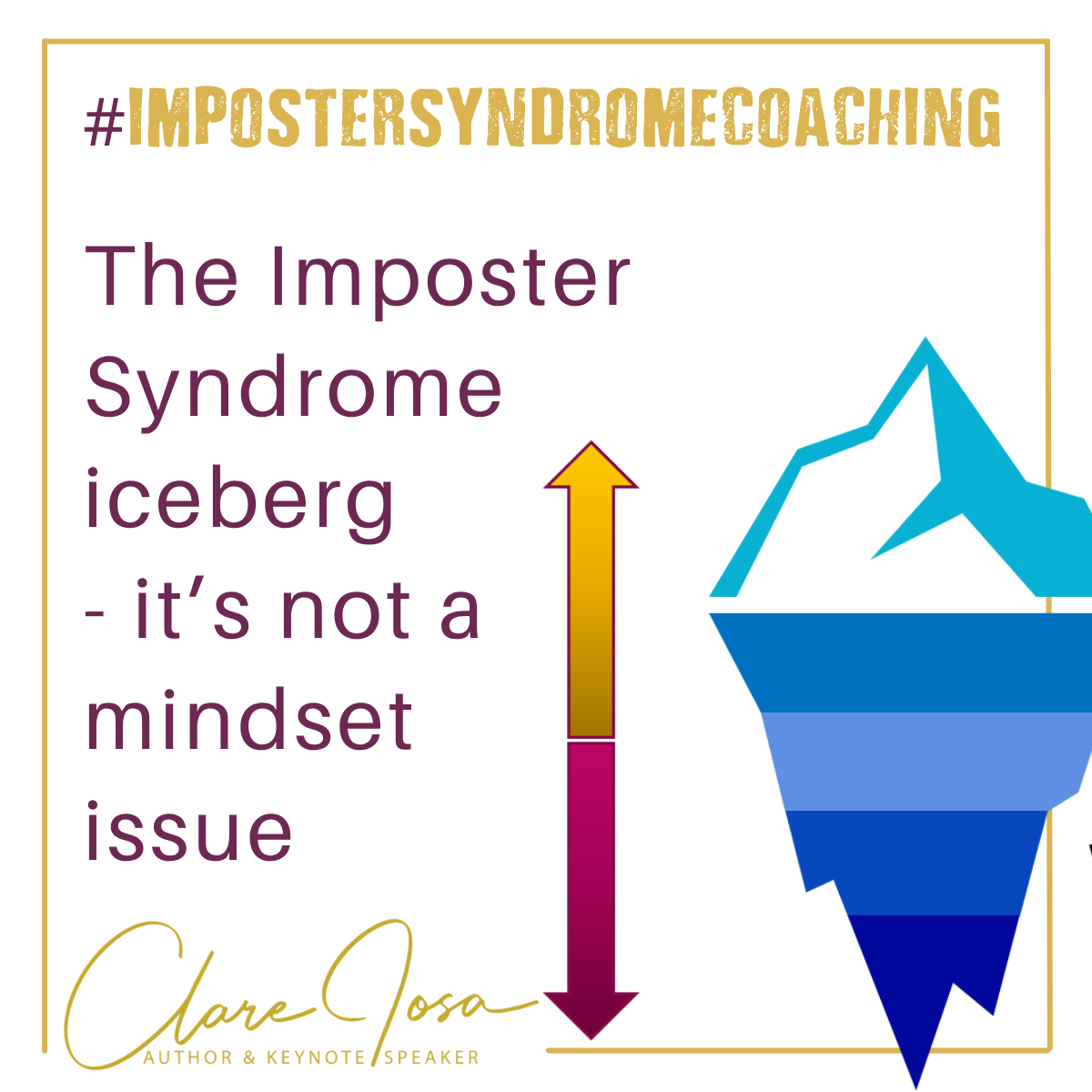
Sharing Policy For The Imposter Syndrome Iceberg
Clare Josa is on a mission to free the world from Imposter Syndrome, so she encourages sharing the name and key aspects of the Imposter Syndrome Iceberg, to help others. Please follow these guidelines:
- Attribution: When sharing, credit "Clare Josa, author of Ditching Imposter Syndrome" and link back to this page, with the clickable text: The Imposter Syndrome Iceberg
- Restrictions: Content may be used for personal or non-commercial purposes only, unless otherwise agreed and licensed. Sharing in free-to-view public articles, podcasts, videos, and social media posts is permitted, with proper attribution, but not in marketing materials, lead magnets, or paid programmes.
Thank you for wanting to make a positive difference in the world, whilst also respecting Clare Josa's intellectual property rights.
The Imposter Syndrome Iceberg
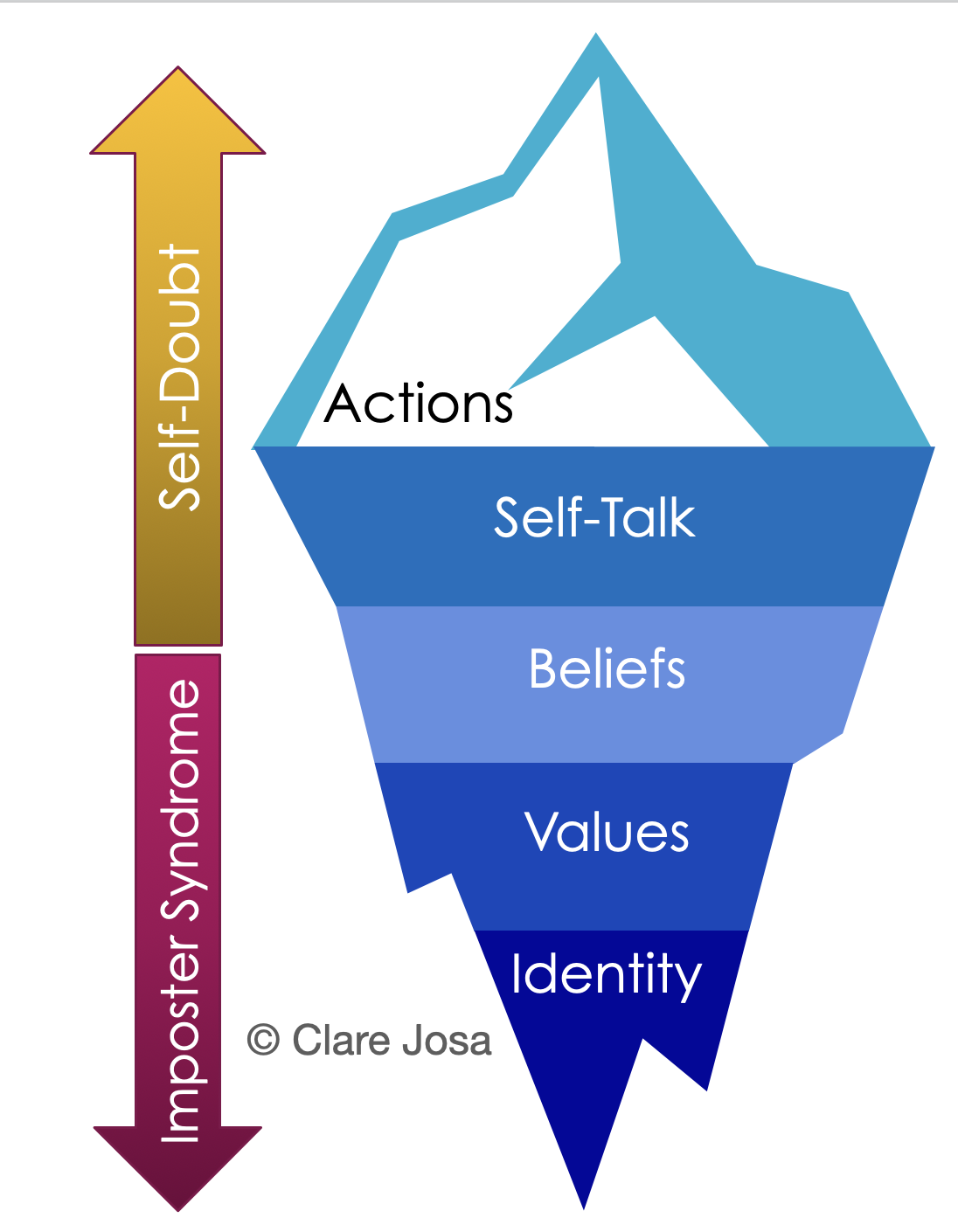
Imposter Syndrome is not the same as self-doubt, as Clare Josa discusses here. It is not a normal, healthy part of growing and stretching comfort zones.
It's a deep fear that you will be found out as somehow not good enough, despite external evidence that you are.
And whilst the thoughts we think are the most obvious surface-level symptom, they're the 'effect', not the 'cause'. So Imposter Syndrome interventions that focus primarily on our thoughts are like putting a sticking plaster (Band Aid, for our American friends) over a broken bone.
The Imposter Syndrome Iceberg shows us that Imposter Syndrome is driven by below-the-surface factors, deep down at the identity level, rather than our surface-level self-talk and limiting beliefs. They're the 'effect'. The identity-level drivers are the 'cause'.
The Imposter Syndrome Iceberg
This short video explains how the Imposter Syndrome Iceberg helps us to better understand Imposter Syndrome, and to select support and interventions that clear it out at the causal level, rather than just easing symptoms.
The video takes you through the Imposter Syndrome Iceberg model stage by stage, so you can understand how it was developed and why it's such a useful coaching model.
And if you're a coach and you want to explore whether you've outgrown your current toolkit and if it's time to make a deeper difference for your clients, here's a research-backed, quiz-style assessment to give you a personalised report and action plan.
The Imposter Syndrome Iceberg is loosely developed from Gregory Bateson's original work on the logical levels of development and change, which was itself grounded in Russell’s theory of logical types. But whereas in the NLP world (Neurolinguistic Programming) these levels are seen as non-hierarchical, but in the Imposter Syndrome Iceberg model they are. Addressing the identity-level drivers for someone's experience of and susceptibility to Imposter Syndrome will shift their values, beliefs, thoughts, and actions. Working on the thoughts might have an effect downwards to the identity, but it's likely to be much weaker.
It is also important to consider the impact of the environment in all of this. In Clare Josa's Three Amplifiers coaching model she explores how Culture, Environment, and Habits impact a person's susceptibility to Imposter Syndrome, burnout, and toxic resilience, as well as the role these amplifiers play in performance, productivity, and wellbeing.
Clare Josa's Natural Resilience Method® is built on the Imposter Syndrome Iceberg and her Safe to THRIVE™ frameworks), and it addresses Imposter Syndrome from both directions: cognitive as well as identity-nervous-system, and for most effective results, the nervous system work comes first.
Why is it so important to clear the triggers and causes of Imposter Syndrome, instead of just easing symptoms?
Because of the Two Types of Fear - covered in detail here.
In summary, in her books and teaching, Clare Josa talks about two types of fear:
legitimate fear
This is the body's natural self-protection response, when physical danger is present, such as that sabre-toothed tiger, or parachuting out of a plane.
mind-story fear
This is the fear-stories our minds tell us: the what-iffing, worrying, and catastrophising about what might happen, even though it likely won't.
So what happens is that a person is telling themselves mind-story fear thoughts about how they might be found out as a fraud, how people might realise they made a mistake hiring them, how others might realise they're not good enough...
... and by the time the conscious mind realises these thoughts are running, the unconscious mind and nervous system has already fired off self-sabotage behaviours to help keep the person safe from the perceived threat.
Your thinking mind isn't making your biggest decisions; your nervous system is.
Clare Josa
The identity-level drivers feed direct into our subconscious mind-story fears, without any input from the 'thinking mind', and directly firing off nervous system fear-based responses that delegate our actions to the primal part of the brain, whose core purpose in that context is to protect you. It doesn't care about your presentation or client pitch.
Clare Josa explores this in more detail here in an article about why the amygdala always wins, and why coaching mindset isn't enough.
That's why to truly release Imposter Syndrome, a person needs to do the work at the bottom of the Imposter Syndrome Iceberg - at the identity level.
This video explains how symptoms-first coaching can leave people stuck in the 'dandelion trap'. And the Imposter Syndrome Iceberg coaching model is designed to prevent this, but without ending up in accidental therapy.
And that is key to working safely and effectively with the Imposter Syndrome Iceberg:
It's essential to have evidence-based training to be able to support someone to resolve the root causes of their experience of Imposter Syndrome, but without forcing them to look for the 'causal event' or playing archaeologist with their past. That's therapy, not coaching.
In this work, when we talk about 'root cause' we don't mean a single event, because unless it was a one-off trauma, that's unlikely to exist. And ferreting around looking for it keeps a client stuck looking in the rear-view mirror. It risks disempowering them, thinking that Imposter Syndrome is the 'fault' of someone or something in the past over which they have no present-day control.
Instead, as 'root cause', we mean the core subconscious driver at the identity level. It's usually some form of 'secondary gain' - a subconscious self-protection mechanism the person developed many years ago that is now out of date. Healthily resolve that and the Imposter Syndrome melts away.

root cause doesn't mean origin story
When working with someone at an identity-level, it's essential to have had the formal training needed to be able to safely resolve the hidden drivers of Imposter Syndrome, without sliding into accidental therapy.
Avoiding Vicarious Trauma
This video explores the risks of vicarious trauma for the coach / mentor, if working at an identity-level with clients, without adequate training.
If you're using therapy-adjacent techniques that encourage a client to look for triggers and causes in their past, you risk retraumatising your client, as well as experiencing yourself the genuine biological impact of hearing client stories that you cannot 'unhear'.
Whilst the Imposter Syndrome Iceberg is a powerful coaching model that helps us to support clients to clear out Imposter Syndrome once and for all, doing identity-level work with clients without proper training risks causing unintended harm to both the client and the coach.
And too many current Imposter Syndrome trainings in organisations use therapy-world techniques without first giving people the years of training required to use them safely.
To learn how to do identity-level work without falling into the accidental therapist trap, creating breakthroughs that clients will love, find out more about training with Clare Josa to certify in this work.
Want To Find Out More?
Here are some ways to find out more about the impact of the Imposter Syndrome Iceberg on how we approach Imposter Syndrome, self-doubt, confidence, and personal performance.
ditching imposter syndrome book
There's a whole section on the Imposter Syndrome Iceberg in Clare's 2019 book. It guides you through the model, then shares practical strategies that have helped many thousands of readers to create breakthroughs.
Available in hardback, paperback, Kindle, and audiobook formats.
The imposter syndrome hacks™ app
The app is grounded in safe to THRIVE™ work, and supports you with creating shifts at all levels of the Imposter Syndrome Iceberg.
It also has hacks for taming your inner critic, turning it into a genuine cheerleader, and waving goodbye to Imposter Syndrome, once and for all.
coaching imposter syndrome book
Written for managers, leaders, HR professionals, coaches and consultants, Clare Josa's 2025 book - Coaching Imposter Syndrome - guides you through how to use strategies developed from the Imposter Syndrome Iceberg to spot the early warning signs in team members and to know when to offer support.
Want to share strategies with colleagues & clients?
Clare Josa teaches deep-acting strategies for the identity-level work in her coach certification programmes, and she covers how to use the Imposter Syndrome Iceberg to spot who in your teams might be experiencing Imposter Syndrome, in her keynotes and corporate workshops. Scroll down to find out about working with Clare.
Don't Know Clare Josa Yet?
Clare is considered a global authority in the fields of Imposter Syndrome, burnout and sustainable performance for individuals and teams. She has been an international keynote speaker for over 20 years.
Her research is cited in PhDs and taught on MBAs, worldwide, and she is the creator of the life-changing Safe to THRIVE™ and Natural Resilience Method® frameworks, which she teaches at Facilitator and Master Coach levels, as well as in the world's first Imposter Syndrome App - Imposter Syndrome Hacks™.
The author of ten books, a reformed engineer, and the former Head of Market Research for one of the world's most disruptive brands, she blends science-backed practical inspiration with demystified ancient wisdom, to help you create breakthroughs in ways that are fast, fun and forever.
