
We need to talk about International Women's Day. Yes, I know that at the time of writing this, it's still months away. But I'm seeing lots of companies making decisions about it ahead of Christmas, so I want to share this now, before it's too late.
First, I need to start with a rant.
The 2026 International Women's Day Theme Is NOT:
"Give To Gain"
That's the alliterative, vaguely-meaningless word salad theme chosen by the self-apointed marketing agency whose sole 'right' to pronounce the International Women's Day themes is them owning the .com domain. They have no authority to set the theme, and the IWD theme is actually decided by the United Nations. Their global theme won't be published until early 2026.
The marketing agency , whose IWD website fails to provide transparency over who they are, or where the sponsorship and fees paid by companies go, say the theme for 2026 is about 'forging gender equality through abundant giving' - by women, to women - and cultivating 'a mindset of generosity and collaboration'.
But if you pause for a moment between taking cringe-worthy selfies with the embarrassing, prescriptive, marketing-agency-dictated pose, if your organisation runs with this theme in 2026, it's not going to land well and could seriously backfire.
The purple cupcakes being thrown at the walls is likely to be the least of your problems.
How will the women in your teams feel about being told by their employer that they have to give even more, to 'gain' what should already be theirs by law?
It risks creating a toxic narrative where women feel they are being told that the reason why they don't yet have equality and equity is because they haven't given enough. But women are already doing a disproportionate amount of the 'giving', both within your organisation, and in their home lives.
And 'giving to gain' is not about the alleged 'generosity' that the theme claims to inspire; it's giving with an agenda. That's not going to sit well with most of your team members.
It plays into the 'fawn' element of the fight-flight-freeze-fawn response that so many women are running, especially if they're experiencing chronic stress or burnout, or have been a victim of trauma: fawning (aka people-pleasing) is all about subconscious self-protection through over-giving, in order to feel safe and get what you need or deserve.
If you promote this catchphrase for your IWD2026 events, it's not a neutral or positive message. You're risking a gender-regressive, psychologically harmful, victim-blaming message that's incompatible with the 2010 Equality Act distorting your positive intentions.
Equality is an employer's legal obligation, not something that should ever be dependent on women's behaviour or generosity of spirit. And since women tend to over-give more than their male colleagues already, promoting this concept risks reinforcing gender stereotypes.
So my strong suggestion is to wait until the United Nations publishes the official International Women's Day 2026 theme, and work with that.
Next: We Need To Talk About How IWD Events Aren't Moving The Needle
The Fawcett Society monitors the UK's gender pay gap and they found that progress went backwards in 2024. The gap grew.
And we've seen a trend this year of companies making policy decisions that are going to make things even worse, with return-to-office mandates being shown to hit women harder than men, and mental load and burnout at an all-time high.
So for 2026, please be intentional about International Women's Day. Don't just rinse-and-repeat what you did last year.
And then we come onto the crux of things. You want to celebrate the women in your teams. You want to inspire and support them. But:
How can you make the changes last longer than the cupcakes?
I encourage you to be intentional around what you choose to do for your teams for International Women's Day in 2026.
Plan events that will make a measurable difference. Do things that matter. By all means make it fun, but make it have impact, too.
How can you do this?
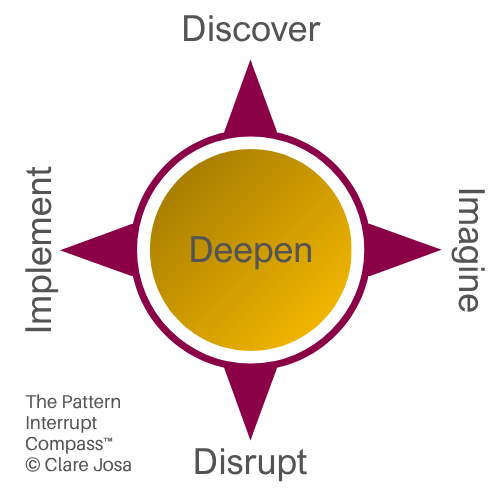
The Pattern Interrupt Compass™ is a way to make decisions that lead to high-impact, low-stress change.
You go round the four compass points, starting at north, then return to centre to review what you learned, to deepen the impact, and to see where else you could apply these strategies.
How can you use this to help you design a needle-moving International Women's Day?
1 - Discover
Don't assume you know what's needed or wanted for International Women's Day. Get data - ask people. And don't ask people what they want - they'll mainly give you ideas based on what they think is possible, what you've already done. Ask them how they'd like to feel afterwards, and how the organisation could achieve that.
2 - Imagine
Imagine anything were possible. What would you love your International Women's Day initiatives to achieve, or create? What impact do you want your event(s) to have? What does the data from #1 tell you?
3 - Disrupt
Here's the bit most initiatives miss out: you can add new ideas into old 'paradigms' - I know - I loathe the word, too. But for you to achieve a different outcome, are there processes, beliefs, assumptions, ways-of-working that need to be disrupted? How could you get buy-in for that?
4 - Implement
Now it's time for the 'doing'! Run your International Women's Day events. Love every moment. Collect feedback, ideas, and 'imagines' for next year. Then it's time for a cuppa and a brief pause.
5 - Deepen
And now, returning to your centre, what did you learn? What worked brilliantly? What might you adapt for next time? And where else could you apply what you discovered with these events, to keep the momentum going?
I can help with all of this. Get in touch here.
And if you'd like to find out how to book me as a speaker for your IWD2026 event, I'm breaking the rules and doing something I've never done before. I'm turning down all bespoke keynote requests, so I can run more fireside chat events, just for ED&I networks.
And then after International Women's Day, let's work together to tackle the three amplifiers: culture, environment, and habits.
