Josa Method® Master Coach Certification
Creating identity-level breakthroughs when nothing else has worked.
Advanced Imposter Syndrome Coach Training for Experienced Practitioners.
As a coach, you want to get the best outcome possible for your client.
But sometimes, no matter how hard you try, they seem to stay stuck. You can see there's a deeper level of breakthrough they could reach, but they hold back and don't quite get there.
And you're left wondering what you could have done differently, to help them. If this is you, you're in the right place. You're not doing anything wrong, you've just hit the limit of your current tools.
Why Classic Coaching Falls Short
WE'RE NOT TALKING ENOUGH ABOUT THIS:
With classic coaching, you can only take a client as far as their nervous system feels safe to go.
And for the people you most want to help, that’s not far enough.
You can already see this happening. They subconsciously self-sabotage the very changes they say they want. They hold back from speaking up with their ideas. They settle for 'ok' when they were dreaming of 'great'. And you know in your heart they haven't experienced the breakthroughs you can sense are waiting for them, no matter what you try.
But it's not their fault. Or yours.
It's what happens when we use mindset-level tools to tackle identity-level blocks.
Self-sabotage isn't a mindset issue. It's the client's nervous system trying to keep them safe.
And they have no conscious control over that.
That's why willpower and motivation only get them so far. You’ve probably seen this happen with your own clients.
The primal part of the brain and the body work together to assess risks and danger: is this safe for me to do? Primal brain and body decide how to handle the threat, before the conscious, cognitive, thinking brain even spots there's a problem.
So you can't 'mindset' your way out of self-sabotage.
Coaching is grounded in the assumption that a person just needs to change some thoughts and beliefs, find some willpower, and they'll achieve their goal.
But their thinking mind isn't the part controlling their biggest decisions.
The part of the client that drives their actions is not the part classic coaching is working with.
Coaching assumes the client's thinking mind is making their choices.
It works on the equation that:
Mindset + Willpower + Moral Support = Change
It's stuck in a model from the 1600s by Descartes called 'Cartesian Dualism', which assumes that body and mind are split and separate.
But they aren't.
And traditional coaching is treating identity-level challenges as somehow coming from 'faulty thinking'.
But they aren't.
They're coming from subconscious self-protection, driven by the body's nervous system.

When coaching ignores the body, survival mechanisms win out against cognitive tools. Every. Single. Time.
If you’ve ever wondered why a brilliant client couldn’t achieve or sustain a breakthrough, this is why.
Mindset-only methods create temporary uplift, not identity-level transformation.
They help clients feel motivated for a while. But they don’t resolve the root causes of the subconscious blocks, so people crash back into their old, safe patterns.
Like dandelions between paving slabs, the limiting beliefs and self-sabotage will keep coming back if they were only cleared by thinking differently about them.

Neuroscience is clear: mind and body are linked.
People's hidden blocks aren't stored in the thinking part of their brain; they're stored in their body and the limbic nervous system.
You can't 'think' your way out of the nervous system being on high-alert and stopping you from making changes.
This means that: any work that wants to create transformational change needs to start with helping the client's nervous system to genuinely feel safe first.
And that's identity-level work.
When their nervous system sees every decision as a life-or-death threat...
... it's easy to see why clients don't take the actions their thinking mind wants them to.
THERE'S AN ELEPHANT IN THE ROOM:
Imposter Syndrome
From our 2024 research study, the secret fear of being 'found out' as somehow not good enough or a fraud impacts 62% of people daily or regularly, to an extent that affects their performance and wellbeing.
Our research has also shown that classic coaching, whilst great for self-doubt, can risk making Imposter Syndrome worse by raising awareness of when Imposter Syndrome is going to strike, but not preventing it.
Self-doubt is about what we can and can't do. Imposter Syndrome is about who we think we are.
Imposter Syndrome is one of the most common identity-level issues your clients will be bringing to you.
And you need deeper-than-mindset strategies to clear it, otherwise you're just sharing yet more coping strategies and creating symptom-level shifts.
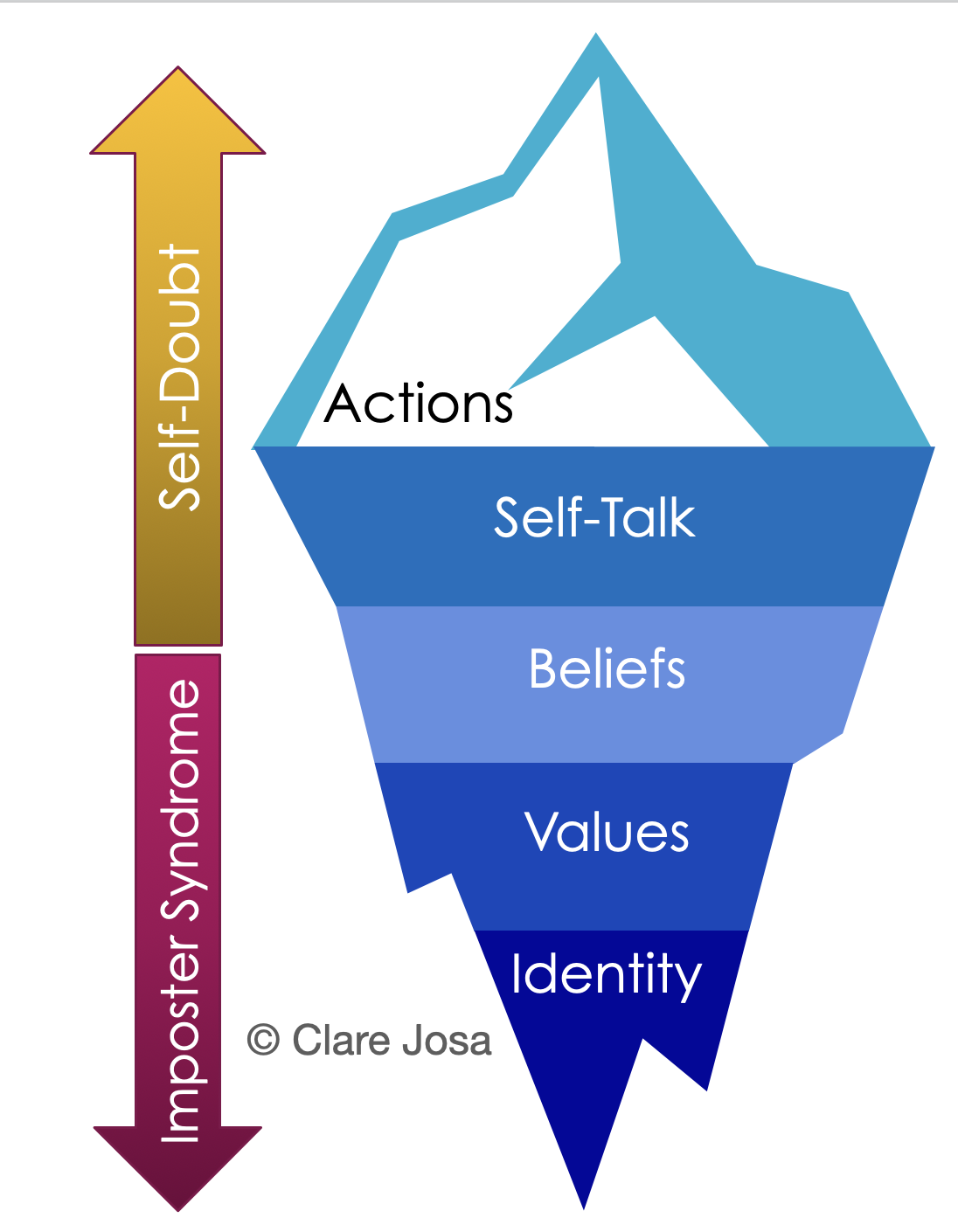
The Imposter Syndrome Iceberg by Clare Josa
When we stick with working at the level of self-talk and beliefs, we miss out the thing that is actually running the show, and limit the breakthroughs a client can achieve.
The good news is:
You don't have to
become a neuroscientist,
an accidental therapist,
meditate on your 29th chakra,
or buy a massage couch,
to help clients create identity-level change.
The Science-Backed Alternative
Identity-level, nervous-system-led, trauma-safe coaching.
Clare Josa - Your Master Coach Trainer
It started in 2003.
I was a certified NLP Trainer coaching C-suite level clients, having taken the plunge from my corporate leadership career. But my already-incredible toolkit wasn't getting clients the breakthroughs they deserved.
It was fantastic for mindset change, for clearing beliefs, for realigning mis-matched values. But it was still stuck at the surface level of symptoms - effects, not clearing causes at an identity-level.
As a Masters Degree Engineer and Six Sigma Lean Manufacturing specialist for over a decade, I wanted root cause solutions, not surface-level fixes, for my clients. I wanted them to feel truly free, not to keep looking over their shoulder for Imposter Syndrome and subconscious self-sabotage to pop back up.
So I studied and qualified in hypnotherapy, in reiki, in the Enneagram, as a meditation teacher (and published two books on the subject) and yoga teacher, as an EFT Trainer, a polyvagal therapist, and more. I studied the neuroscience, physiology, and psychology of mental health and personal and team performance. I tested, experimented, measured, combined, cleared out the fluff - and I created and tested solutions. It took me over ten years.
I was blown away by the depth of transformation clients were getting, and how much easier it was for them.
Over time I reverse-engineered what was actually creating lasting change.
No guesswork. No padding. Just the key elements that consistently delivered identity-level breakthroughs.
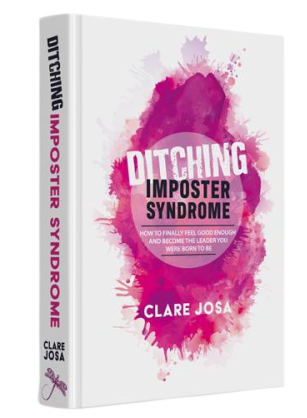
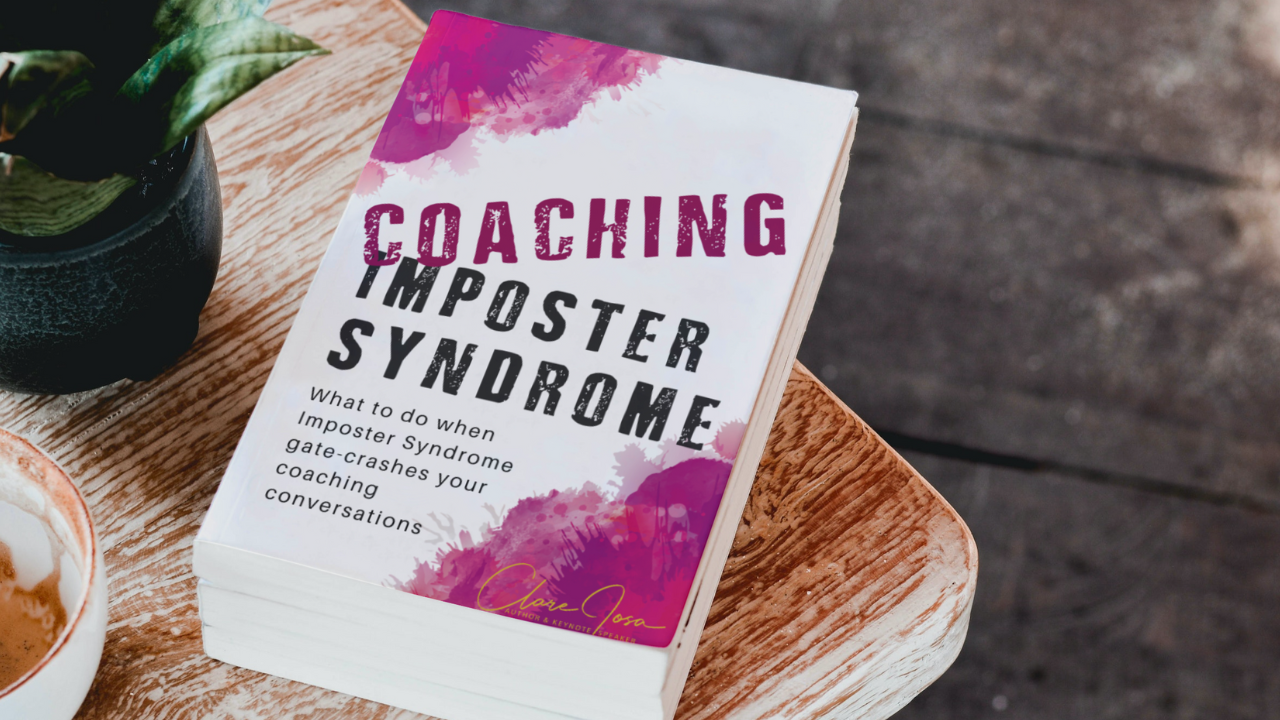
I ran three international research studies into Imposter Syndrome and burnout, to inform these processes and further refine them. This research is now cited in PhDs and taught on MBAs, worldwide. I published two best-selling books on the subject of identity-level change, especially fully clearing Imposter Syndrome, and hosted a podcast with over 30,000 listeners in 147 countries.

But the best bit?
When I started teaching these identity-level coaching processes to other experienced coaches, they got results at least as good as mine, and often better, because they bring their own style and strengths into the mix.
And although I can secretly hug-a-unicorn with the best of them, my inner engineer is data-driven. So I also created ways of coaches and clients being able to objectively measure the change, so they can see, as well as feel, that the coaching has worked.
This is what became the Josa Method® Master Coach Training.
the josa method®
The Ingredients
The Josa Method® is about coaching and mentoring Mastery-level strategies, with an inspired blend of:
- practical neuroscience,
- simple polyvagal techniques to reset the nervous system,
- performance psychology,
- evidence-based proven approaches,
- data from our research studies,
- demystified ancient wisdom,
- and real-world replication proven by past grads.
All grounded in an engineer's practical common sense, and delivered with a generous dollop of humour.
And there's a key reason why Clare's strategies are so effective:
And the Josa Method® doesn't just reset the nervous system once.
It helps clients to retrain it to get off high-alert, long-term.
This increases their natural resilience, lowers their baseline cortisol levels, reduces the fight-flight-freeze stress response, and prevents burnout.
Whether someone has experienced deep trauma, or long-term chronic stress, or burnout, or a micro-managing bully-boss, or an abusive relationship, or Adverse Childhood Experiences, their nervous system can become dysregulated - stuck 'on', wired to look for threats.
This is autonomic - outside of their conscious control.
This causes something called 'hypervigilance', where a person is constantly in 'red alert' mode. And your coaching can be lumped in with the perceived threats.
Neuroscience is key here, but it's not just the brain: the vagus nerve holds the key to re-regulating the nervous system so a person can finally feel safe to change, and put an end to subconscious self-sabotage.
That's why vagus nerve and 'feeling safe' nervous system work is integral to what you'll be doing with the Josa Method®. It's the vital first step in identity-level change.
And there's more:
The Josa Method® goes beyond 'trauma-informed'.
It's trauma-safe at every single stage. By design.
Creating identity-level change that's proven to be effective and safe.
Most Coaching Models Make A High-Risk Assumption
Most coaching models assume that clients are basically feeling ok, with strong mental, emotional and physical wellbeing, and that they're ready to go for their goals.
Coaching assumes:
- no trauma history.
- no secondary gain (the subconscious unmet needs that make us self-sabotage).
- no identity-level fear.
Just a few limiting beliefs, some lack of clarity and accountability, and perhaps a dose of negative self-talk.
But that's not reality for most of the population.
Some scary numbers: the World Health Organisation estimates that 70% of the world's population has experienced trauma, and 1 in 15 has some form of PTSD.
That includes your clients.
Your role as a coach isn’t to heal trauma. It’s to stop trauma-affected nervous-system responses from derailing coaching.
And our research studies show that complex trauma (long-term, smaller events, like toxic workplaces or abusive relationships) are one of the biggest risk factors for Imposter Syndrome.
The Josa Method® helps you to do the deeper work, whilst intentionally preventing coaches from accidentally re-opening Pandora's Box for clients, preventing retriggering past trauma, or creating new trauma.
It's also designed to ensure Master Coaches to stay safe from 'vicarious trauma' - where client experiences trigger or retraumatise the coach.
The Josa Method® makes it safe to do identity-level work, using tools that are nervous-system-friendly, where you can clear root causes without having to dig around in a client's past to find something or someone to 'blame'. No 'accidental therapy' in sight.
And What About Neurodivergence?
This is something else most coaching models ignore completely.
It is estimated that Autism, ADHD, and other non-typical neurotypes affect 15% of the population. That figure is significantly higher in leadership roles. And for many of these people, classic coaching doesn't work.
The way neurodivergent brains are wired and the decades of a person's lived experience of masking and trying to feel 'safe' in a world that's not wired for them can impact safety perception, sensory load, hypervigilance, overwhelm, and dissociation through shutdown.
And our research studies show that identity-level issues like Imposter Syndrome can be much harder for a neurodivergent person, because the coping strategies overlap.
Their nervous system often responds differently to external stimuli and negative thought processes than a neurotypical nervous system, and becomes dysregulated more easily. The way they process information and emotions can differ from neurotypical clients. They're likely to 'break' your 'classic coaching' models.
They need a nuanced approach that doesn't assume the equation of:
Mindset + Willpower + Moral Support = Change
Using these kinds of mindset techniques with someone who has ADHD, autism, or both, can lead to shame and failure of the coaching intervention, with the client blaming themselves. In addition, many neurodivergent people struggle with complex verbal instructions, so you need to communicate differently.
Clare Josa is autistic and ADHD, and neurodivergence-supporting strategies are designed into the tools and concepts you'll be working with. And the Josa Method® methodologies you'll be learning have made a life-changing difference for neurodivergent students and clients, around the world.
The Josa Method® Master Coach equips you to coach autistic, ADHD and other neurodivergent clients safely and effectively, in ways that are aligned with their needs.
Your Primary Lenses
Imposter Syndrome & Burnout
In the Josa Method® Master Coach training your primary lens for this work will be Imposter Syndrome, because it's the most common identity-level coaching challenge you'll see with your clients, even if they're not consciously aware that this is what's driving their self-sabotage.
You'll gain tools that support clients to wave goodbye to Imposter Syndrome, once and for all. No more reframing it as a good thing or drowning in coping strategies.
You will become a genuine expert in a field that's full of myths and misinformation.
You'll also become an expert in burnout, which our 2022 research study shows has a causal relationship with Imposter Syndrome. It makes Imposter Syndrome worse and their coping strategies overlap, increasing the risk of burnout. Combined, they're one of the biggest challenges facing employers and their teams.
Our 2024 study found that 1 in 10 people will think about quitting their job due to Imposter Syndrome and burnout today. It's 1 in 4 every week.
In addition, throughout your training, we also explore how to apply these methodologies and breakthrough strategies to all areas of identity-level coaching, so you can maximise your impact with as wide a range of clients as possible.
And the tutorial calls mean you'll be learning from other students, as well, and how they're applying these strategies, giving you direct experience of a wide variety of real-world usage cases.
Have you outgrown your old coaching tools?
Coaches who join the Josa Method® Master Coach training secretly know they have outgrown the strategies they were previously given.
If you’ve ever felt that sense of ‘I can take my client this far, but no further’, you’re already in the right place.
Your current toolkit is likely to be a mismatch for the depth of transformation your heart is calling you to co-create.
Before we go any further, full disclosure:
If you're wedded to the GROW model, genuinely believe that clients always have all the answers they need inside of themselves, and hate the idea of ever doing anything besides asking questions, then this isn't your course.
But if the next four philosophies feel like relief for you, you’re exactly where you need to be.
How You'll Be 'Breaking' Classic Coaching 'Rules'
The GROW model and similar frameworks are great for foundation-level goal work, but they're insufficient for creating identity-level change.
They assume the client only needs help clarifying goals and planning actions.
They do nothing for subconscious blocks, threat responses, or identity-level fear.
We don't know what we don't know. It took me ten years to create the Josa Method® strategies my Master Coaches are now using. And that was with spending tens of thousands of pounds on training, plus years experimenting, testing, researching, refining.
It's not realistic to expect your coaching clients to figure these strategies out on the spot, during a session. In many situations, if they knew how to change things, they'd have done it.
Yes, they are the expert in themselves and their lived experience. But they don't hold all of the answers they need. And that's ok. In fact, giving them the belief that they should can risk triggering shame and withdrawal from the coaching process.
Non-directive coaching - only asking questions - has its place. But it slows transformation to a snail's pace when deeper-than-mindset blocks are in play.
When someone’s nervous system is dysregulated, endless questions are unhelpful and can even feel threatening, especially if they don't know the answers.
They need grounding, safety, and the smoothest path to answers, not more navel-gazing.
Sometimes clients need more than questions and self-awareness: they need shortcuts and how-to.
With Josa Method® Master Coach work, you'll be professionally and intentionally blending both coaching and mentoring, sharing insights and practical strategies clients can use to create change.
And because the course starts with you applying this work to yourself, too, you'll be a congruent role model for the transformations that await your clients.
And therapy-adjacent tools are not the answer.
Many coaches, with the best of intentions when realising that they have outgrown classic coaching, turn to tools from the therapy world, such as:
All of this crosses the vital ethical boundary between coaching and therapy.
And none of it is necessary to create identity-level change for your coaching clients.
The Josa Method® Manifesto
This is our twelve promises to you, to make sure what you're learning is transformational, raising the global bar on advanced coaching training.
We believe that you and your clients deserve more than just quick fixes and yet more coping strategies that assume Imposter Syndrome is something you’ll have to manage forever. We don't think that's fair, when there are proven ways to truly set yourself free from it - once and for all.
No more lying awake at 3am, worrying if today’s the day someone will find out you’re a fraud or somehow not good enough. No more playing catch-up with the subconscious self-sabotage that's triggered by stuff that 'mindset' doesn't touch.
We go beyond surface-level symptoms, giving you tools to safely and effectively release the deeper, hidden drivers of Imposter Syndrome, so you and your clients can have the impact your ideas and dreams deserve, with courage, confidence, and passion.
You won’t have to go it alone. Forget self-paced self-study (which we all know means never finishing...) or feeling stuck with your only guides being fellow students, who are just as new to this as you... or getting lost and feeling invisible in an online group of 300.
Our approach is built around small-group (20 max), expert-led cohorts, with your inspirational weekly training modules supported by live, expert-led tutorial calls, plus a private forum with our expert tutors, for between-call questions. You’re fully supported every step of the way. You'll have accountability, easily get answers to your questions, and have virtual cheerleading to celebrate your breakthroughs.
You’ll be guided through the main training phase and your case studies by experienced tutors who know exactly how to help you get the most from your training.
With this hands-on support, you’ll never feel lost in the crowd or abandoned to a peer support forum.
We’re with you, helping you shift from information to implementation, so you’re not just learning theory, but building the vital experience that will give you the confidence to go out and support others with what you've been taught.
Forget back-of-beermat brainstormed ideas or asking AI for funky-sounding frameworks – we don’t believe in guessing or relying on random bags of tools. The frameworks and methodologies we teach are rooted in two decades of in-depth research studies, science, neuroscience, psychology, demystified ancient wisdom, and real-world experience.
Plus, they've all been through Clare Josa’s inner Six Sigma Engineer BS filter. So, they're fluff-free and designed to reliably get measurable results for real-world clients.
These aren’t just theoretical ideas. They’re evidence-based, tried-and-tested methods that are proven (yes, with data) to create breakthroughs you'll love.
From start to finish, you’ll be using tools that have been shown to inspire lasting, meaningful change, not just temporary relief. You’ll finish your training with the confidence to use what you have learned to make a difference for others (and you'll have cleared out loads of this stuff for yourself, too!)
Depending which course you're on, you might be learning:
- The Natural Resilience Method® for preventing Imposter Syndrome & burnout
- The HOPE Matrix® for creating cultural change in organisations
- The Rebel RESET™ for kick-starting clients' Rise Like A Rebel® journey and facilitating Women In Leadership masterminds
- Or one of our other proven, research-backed methodologies
The world already has enough quick fixes or sticking plaster solutions for Imposter Syndrome, even though they keep you trapped in the same cycle of secret self-sabotage, perhaps forever.
What we want for you, instead, is real, lasting transformation.
Yes, in-the-moment 'pause' techniques are important, but real, lasting change comes when you release the under-the-surface drivers that allowed Imposter Syndrome to come out to play in the first place.
In our courses, you'll get to go deeper than 'mindset', learning strategies that go beyond masking the symptoms, to clear the hidden causes, throughout the full Imposter Syndrome Iceberg™. You'll learn techniques that work at the cognitive level, and also those that clear the 'muscle memory' of Imposter Syndrome's self-sabotage, including hypervigilance. This combination of techniques is what creates vital shift from 'relief' to 'freedom'!
You'll experience the kind of results that support you to move forward in your career and life with deeper confidence and purpose. This is the kind of transformation that lasts.
By the end of your course, you’ll be empowered to help others do the same – because this isn’t about managing Imposter Syndrome forever, it’s about waving goodbye to it, once and for all. And who wouldn't want that?
You can't take a client to a place your unconscious mind thinks is impossible. And it's tough to be fully present to help a client if your inner dialogue keeps chanting, "Who am I to help them? What if they realise I'm not good enough?!"
So, clearing your own Imposter Syndrome is a crucial first step on your journey towards helping others.
Not only does this help you to be the best coach you can for them, by becoming more of the real you, it subconsciously models to your client that the changes they're dreaming of are possible.
That's why all of our coach training programmes - from line managers to Master Coaches - start with you applying the inspirational strategies you'll be learning for yourself, then we explore how to use them to safely and effectively help others.
Just imagine how different it will feel, once Imposter Syndrome is no longer getting in the way of the difference you want to make, in your life, and in the lives of others!One of the core foundations of coaching is maintaining the crucial boundary between it and therapy or counselling. But the internet is full of well-meaning people sharing techniques that they perhaps experienced for themselves, without realising they are, in fact, specialist, highly-skilled work that should only be led by someone with the right formal qualifications, because of the risk of harm such tools carry.
When you're on a mission to help people, though, it's easy to fall into the 'accidental therapist' trap and try out techniques that go beyond what coaches should be doing.
We're even seeing some employers actively asking staff to do this, hopefully without realising, for example when they tell employees to go and see the in-house Mental Health First-Aiders, if they're feeling stressed and anxious. This turns the MHFAs into untrained, unsupported counsellors and it's a super-bad idea.
The Accidental Therapist trap can also happen when you start unpacking someone's past stories and pain to help them understand their present. When coaching drifts into deep emotional exploration, trying to find things from a client's childhood to explain their present-world Imposter Syndrome self-sabotage and fears, you cross a line - one that could re-trigger long-buried trauma and even a mental health crisis.
Not only does this put clients at risk, but it can take a toll on you, too. Some stories can’t be ‘unheard,’ and carrying that emotional weight isn’t part of your role as a coach.
Psychological safety, consent, and trauma-informed approaches form the foundations of the work we teach.
You'll learn how to guide people safely and effectively, working at the right level to create breakthroughs, without crossing ethical or professional boundaries. And perhaps most importantly, you'll know how to spot the signs that someone needs to be referred on for therapy-type work, before addressing Imposter Syndrome.
Our evidence-based frameworks mean you’ll be able to help clients shift what’s keeping them stuck - without taking on their ‘stuff’ or getting dragged into counselling territory.
No therapy-by-accident. No emotional burnout. No feeling out of your depth. Just proven methods that allow you to create real, lasting change, for your clients and for yourself.
Coaching interventions can feel nebulous. How can you tell if they worked?
That's why the work we teach is underpinned by in-depth research, and this means we've been able to create assessment tools that clients can use at the start and after their work with you, to objectively see the shifts.
Even at just Practitioner level, it's not uncommon for a client's Imposter Syndrome score to drop from 80% (severe) to just 20% (background noise in the questionnaire) in just 12 weeks.
That's an incredible level of breakthrough.
Plus techniques in the programmes, such as MicroWins, and the Imposter Syndrome Hacks™ App's virtual journal, support clients in spotting their shifts as they go through, celebrating each one, reinforcing the changes they're making, helping them to stay motivated, and prompting even bigger breakthroughs.
And if you're working with us on a scalable solution for your organisation, we can carry out a research study before and afterwards, to give you data that will help your CFO see that this was possibly the best investment they've made all year.
We even have a research-backed cost calculator you can use to assess how much Imposter Syndrome might be costing your organisation - in cold, hard cash - and how long solutions would take to pay back. Spoiler alert: sometimes it's just days.
When you’re helping someone make deep, lasting changes, psychological safety isn’t a nice-to-have - it’s non-negotiable. But it doesn't happen by accident. It needs to be designed into the processes.
Without it, coaching can do more harm than good. And that’s especially true when it comes to Imposter Syndrome, because it’s so often rooted in micro-trauma from the past - experiences that might seem small on the surface but have shaped someone’s deepest fears about not being ‘good enough'.
Psychological safety means someone feels safe enough to explore change, without fear of judgment, failure, or consequences. It’s what allows clients to be honest with themselves and with you, without shutting down, putting up a front, or saying what they think you want to hear.
Trauma-informed means you're only using tools that keep clients safe, and protect them from falling into the Accidental Therapist trap we talked about in #4.
But here’s the catch: if psychological safety isn’t there, or a tool treads on the toes of past pain, the brain goes into self-protection mode. That means your client gets stuck in the fight, flight, freeze, fawn response, making creating real change impossible. The client will subconsciously use 'resistance' or 'shutting down' to protect themselves. It’s why so many ‘breakthrough’ techniques fail, leaving people feeling worse instead of better.
In a workplace setting, this is even more critical. If someone doesn’t feel safe, they won’t admit to struggling. They’ll nod along, make the right noises, and leave your session just as stuck as before, only now, they feel even more isolated. This is especially important in HR, where the colleague you're coaching knows your teammates make decisions about everything from promotions to redundancies.
And for you as a coach? Without psychological safety, you risk unknowingly re-triggering someone's suppressed trauma, damaging trust, or even opening up issues you’re not trained to handle - not just in your client, but also for yourself.
That’s why psychological safety and trauma-informed approaches underpin everything we teach.
You’ll understand the hidden signals that show when someone is reaching their emotional edge - so you can guide them forward without pushing too far. And you’ll be equipped to recognise when something is outside your professional remit, so you can refer a client on and avoid accidentally taking on the role of therapist.
This isn’t about playing it safe or watering things down. It’s about doing the work at the right depth, in the right way, so that every breakthrough is built on a foundation of trust, safety, and real, lasting change.
Yes, we know... we all hate audience participation on courses. The forced icebreakers, cringy role plays, and "share your thoughts" prompts that just make you want to disappear. But when it comes to growing as a coach, theory isn't enough – it’s about learning how to apply it.
Theory can sound great on paper. You can rattle off all the right terms, quote the experts, and nod along to every training module. But you're unlikely to implement your new information. Unless you put that knowledge into action, it’s just a bunch of nice ideas.
What happens when you show up for your first real-world client session, if your course stopped at just the 'theory' stage? If you're like most of us, you'll freeze and fall back on the techniques you were comfortable with before the course. That certificate you got for watching a few videos? It doesn't help when you need it.
Not even training videos with simulated client sessions give you what you need, because watching an expert do it doesn't build your own confidence.
Real expertise comes from putting theory into practice, to create real results for real clients. It’s about understanding the nuances of each individual's situation and having the confidence to adapt your approach to get them the best outcome.
That’s why we don’t abandon you once you’ve completed the initial training.
We keep walking by your side throughout your case studies. You’ll get expert support from expert tutors, and even from Clare Josa, as you apply what you’ve been learning to real-world clients, not just coaching swaps with fellow students.
And not only does this help with your first few clients, but you also learn from others’ case study experiences. So by the end of that phase, you’ll have vicariously coached 50 or 100+ people – even if you only worked with a handful of clients yourself.
Yes, it would be cheaper and easier for us to cut you adrift after the training modules. But we don’t think that’s fair.
Instead, we want to support you as you learn how to read between the lines with Imposter Syndrome, to spot hidden patterns, and to apply your knowledge to real-life situations. You’ll develop the skills to guide clients through challenges, knowing when to pivot, persist, or hold space.
No more regurgitating theory. You'll have practical expertise that helps you have a much deeper impact.
PS Our grads tell us that they love looking back at how much they grew as a coach between their first and final case study. They often describe it as 'unbelievable' and rave about how it sky-rocketed their confidence. We want that for you, too.
Did you know we created the world's first app specifically designed to help people set themselves free from Imposter Syndrome? It's called Imposter Syndrome Hacks™.
And if you're on one of our coach training programmes - whether that's at foundation level or moving towards mastery - you'll get a special discounted rate for the app, to share with clients and colleagues, to support them in making faster, deeper changes while they're working with you.
Just imagine being able to give them 'homework' of watching a short course in the app, or practising a certain technique each day, or celebrating their MicroWins in the virtual journal - and how that will influence the shifts they'll have created before your next session?
The app helps to reinforce what you're doing with your coaching, and gives clients practical things they can do between sessions to increase the impact of your work.
And if you're certified to support clients with our Imposter Syndrome Bootcamp™ or Stepping Up To Lead trainings, you can give your clients access to the 'private podcast' for that level of course inside the app, meaning they've always got an audio to guide them through their current technique.
This makes it easier for them to practise, and over the past years of doing this, it has been shown to get them deeper, faster results, because they're making more progress between sessions.
It's like them having a mentor in their pocket, on their phone, and it means that in your coaching sessions you can focus on the strategies that have more impact, because the app is helping them to lay the foundations.
We shouldn't have to say this, but recent trends in the industry mean we do:
Ethics and integrity are non-negotiables in coaching. If you're looking to take shortcuts or bend the rules, our courses aren't the right path for you. But if you’re committed to doing the right thing, even when no one’s watching, then you're in the right place.
Coaching is a privilege. You're not just helping people achieve their goals; you're guiding them through some of the most personal and transformative moments of their lives. That’s why we build ethics and integrity into everything we do – not as an afterthought or a once-and-done add-on module, but as the foundation of everything we teach.
From managing client boundaries to holding space for deep work, and even knowing when to refer someone to another professional, integrity should guide every decision. It's about being transparent, honest, and staying true to the trust your clients place in you.
But it's not just about them: it's about you. Ethics and integrity are one of the reasons why all of our coach-type training courses start with you doing this work for yourself, before learning how to support others with it. After all, if a coach is crippled by Imposter Syndrome, it's hard for them to congruently support a client in setting themselves free from it.
And it’s about being ethical in the business side, too – pricing your services fairly, marketing with honesty and without using fear as a sales strategy, and never promising what you can’t deliver.
If you’re using tools and strategies that don't honour those values, you might see short-term wins, but you'll sacrifice long-term trust and success. And let’s be real – without trust, the whole coaching process falls apart.
When you’re grounded in ethics and integrity, you’ll be able to make confident decisions, offer the best service, and build a reputation that lasts as being a great coach who helps clients to achieve results they never imagined were possible. And that’s the kind of success that matters.
The real learning starts once your training ends. And that's why post-course support is so important. It sets you up for long-term success.
Once you've completed your certification with us, you'll be eligible for grad membership. This means:
- You’ll have access to CPD (Continuing Professional Development), ensuring you can keep evolving your practice and stay on top of the latest techniques. You’ll also get ongoing access to your training materials, including updates and grads-only masterclasses, for as long as you want to stay a grad member.
- You are not alone! Finding your tribe is essential. Connecting with other coaches who are on a similar journey means you can get answers to your questions, celebrate your successes with people who truly 'get' it, and get advice on client 'foibles' when you need it. You don’t have to figure it out alone.
- Coaching supervision is part of the membership too. It’s a space to reflect, develop your skills, and keep growing as a coach, whilst also learning from your fellow grad coaches in the process.
This ongoing support makes a real difference – not just in how you work, but in the impact you have with your clients. When you feel fully supported, you can do your best work.
Here Are Some Of The Clients You'll Be Able To More Easily And Effectively Help, Once You're A Josa Method® Master Coach
This course is about identity-level, nervous-system-led, trauma-safe coaching for complex humans.
Mastering Identity-Level Change
There comes a moment when the tools you were given stop matching the depth of work you know you've been called to do.
If you're an experienced coach, therapist, or practitioner, whether in-house for your employer or externally, if what you've seen so far is resonating with you, you're ready to learn how to master identity-level change.
There are three core phases to the Josa Method® Master Coach programme.
They take you from personal transformation to mastery-level delivery, and finally to confident, repeatable results with a wide range of clients.
Phase 1: For Yourself
3 months
You start by doing the transformational Josa Method® work for yourself, clearing your own silent saboteurs, including Imposter Syndrome, aligning yourself with your inner Master Coach at an identity-level. Once you feel these shifts in yourself, you won't want anything less for your clients.
Phase 2: For Others
3 months
Then, having cleared your blocks, you'll learn how to safely and effectively do this depth of work with others. This includes tools and strategies that Clare doesn't teach anywhere else - her 'secret sauce' strategies that work even if clients feel they've tried everything. This is where you do the deeper identity-level work.
Phase 3: Implementation
6 months
Information makes no difference unless you implement it. And this course is about moving into mastery in your coaching, not just having more knowledge. So you'll be fully supported in completing six client case studies, which past grads say is the most transformational part of this programme.
And throughout all three phases, you’re doing identity-level work without becoming an accidental therapist. The method is designed - engineered - to keep every stage safe, structured and coach-appropriate.
Key Mastery Areas
Clare is happy to answer any specific questions you might have on the full syllabus in your post-application call. Here are the core capabilities you will master, each essential for identity level change.
You will learn how to help a client shift out of the survival states that block change. When the autonomic system is on high alert, the thinking mind is unavailable and the client appears resistant or inconsistent. You will learn practical, safe ways to support regulation without entering therapeutic territory. These techniques include practical tools to work with the vagus nerve, as well as nervous system regulation techniques from the world of meditation and yoga.
This includes knowing what to do if a client shuts down, becomes overwhelmed, dissociates, or moves into fight or flight during a session.
Once a client feels safe at a physiological level, identity work becomes possible and sustainable.
You will learn how to work safely and effectively with a wide range of clients, including those who are neurodivergent, trauma affected, overwhelmed, or stuck in long-term, chronic stress responses.
This includes knowing how their nervous system may respond to coaching, how to pace sessions, and how to avoid interventions that can retraumatise or destabilise.
You will learn how to support profound change without crossing any ethical boundaries, without diagnosing, and without relying on therapy methods.
This is coaching that is safe by design.
Secondary gain is often the true reason a client repeats a pattern, even when they say they want change. And it's the core reason why even the best traditional coaching can fall short.
You will learn how to identify the unmet needs and hidden safety strategies that keep someone looping - secondary gain - and safely and effectively resolve this inner conflict.
You will learn how to clear these patterns without digging through personal history, assigning blame, or triggering past experiences.
We'll draw on techniques like 'parts integration' from the world of advanced NLP, and also a proprietary form of non-verbal EFT that Clare has developed that can safely and effectively resolve secondary gain, even when the client doesn't consciously know what it is.
This is the level of work that clears the root cause of self sabotage, without crossing over into therapy, so clients stop reverting to old behaviours after a temporary breakthrough.
Some blocks cannot be reached with questions, reflection, or mindset tools alone. Sometimes the client doesn't consciously 'know' what their block is, and sometimes delving into the 'story' isn't safe or appropriate.
So it's essential to have tools that allow a client to release and resolve past blocks, without having to dive into the drama and pain.
You will learn coach-appropriate, non-verbal processes that release limbic stored tension and protective patterns without retraumatising the client and without touching the therapeutic domain.
These processes, which include a non-verbal form of 'tapping' that Clare has developed for exactly this purpose, allow a client to experience profound internal shifts that would be impossible through thinking alone.
They are grounded in physiology and safety, not storytelling, and they create visible and measurable changes in a client's experience of life.
This isn't 'back of beermat' or 'AI-generated' frameworks. You will learn how to work with proven, replicable methodologies for identity level change that have been refined over more than twenty years and tested across thousands of clients. This includes Clare Josa's Natural Resilience Method®, The HOPE Matrix®, and BASTA!™ frameworks.
You'll experience and understand why change becomes possible at certain stages and impossible at others, and which cognitive, psychological, and nervous system foundations need to be in place first.
You will learn how to work with the natural arc of identity growth rather than clients 'pushing on through', and how to design sessions that align with the way the brain and body actually integrate change.
You'll build on your existing coaching or therapeutic skills to add mastery to designing client sessions.
This includes how to work with energy (engineer-approved), the power of intention, sequencing, nervous system readiness, and the timing of interventions.
You will learn how to spot when a client is genuinely ready for identity level work and when they need a different approach, with a strong emphasis on safety and when to refer on, if needed.
You will learn how to create sessions that lead to sustainable, measurable behavioural change rather than motivational spikes that fade within days.
New For 2026
Deep-dive modules on polyvagal coaching and neurodivergence.
Updates from the latest academic research, from Clare's MSc in the Neuroscience and Psychology of Mental Health.
In-person intensive week to learn the deepest techniques with Clare and your fellow students.
How Will You Learn?
Here’s how we turn this from theory into transformation.
This isn't a get-the-certificate-for-watching-videos course. It's not about 'peer support' self-study.
It's about deeply developing the skills you need to move into mastery in your coaching. The Josa Method® Master Coach is engineered to create profound change, as simply and easily as possible.
Students join us from all over the world, and this training is designed to fit around busy schedules. But, yes, it does require you to block out the time in your calendar to get the most from it.
Here's what's waiting for you:

15 high-impact weekly modules
1 a week plus reading weeks
Using accelerated learning techniques, these video lessons make it easy and fun to learn the theory and practical techniques, fitting round busy schedules. Allow 2 hours per week.

small-group online tutorials with clare
twice a month for 6 months
Clare shares ninja strategies, insights directly relevant to you and your client field, and you can get answers to your questions and pick her brain on all aspects of this work.

in-person* retreat in the UK
live-streamed & recorded
This inspirational 5-day retreat is where Clare teaches the deepest, most advanced techniques - her 'secret sauce'. It's recorded and live-streamed, if you genuinely can't make it.

six supported case studies
monthly tutorials + forum
You're fully supported to implement this work using six client case studies. You'll get monthly tutorial calls with Clare, plus between-call answers to your questions in the forum.
* Your course includes the cost of the retreat training, session recordings, training materials, lunches, and break time snacks. You can stay at your choice of local accommodation, to suit your budget.
And you also get:
You get a private forum where you can share your lightbulbs and breakthroughs between calls, and get answers to your questions from both fellow students and Clare.
Right on your phone, you'll get a private podcast with all of the key techniques from your training as instant-play audio files. It's great for practising them for yourself, and even playing to a client during a session, while you build your confidence.
Once you're working with clients on this - even case study clients - you'll get access to tools like the Imposter Syndrome Assessment Tool, client MP3s for key techniques, both free and paid supporting courses, the latest research white papers for your clients, and tools your clients can use for organisation-wide impact assessment of Imposter Syndrome, burnout, and toxic resilience.
When's the next cohort?
Dates For Your Diary For 2026
Calls are twice-monthly at 3pm on Wednesdays, UK time.
20th April
Cohort Start Date
21st - 25th September
In-person intensive, UK
October 2026
Case studies start
Apply To Join
There Are Only 10 Master Coach Student Places.
We do this so you get the quality of training and feedback you deserve.
Joining is by application: a non-scary 10-minute application form, followed by a short call with Clare to check that this is a great next step for you, and answer any questions you might have.
We'll hold your place for 48 hours after that call.
What's The Investment?
This is a one-year, fully supported, identity-level coaching mastery journey, not a badge-collecting CPD course about Imposter Syndrome.
The investment for this programme is £9,995 + VAT.
The early bird rate is £7,995 for those who apply and confirm their place before 28th February 2026. A 12-month payment plan is available.
Most graduates recoup their investment through a single well-designed corporate engagement or a handful of 1:1 intensives, often before the end of the course.
And for those coaching for their employer, you can recoup the investment by preventing just one person from quitting due to Imposter Syndrome - and our research shows that 1 in 10 of your team members considers it every single day.
Join For April 2026
£
7,995
Early Bird
Confirm your place before 28th February and save £2,000.
All prices are excluding UK VAT, if applicable.
12-month payment plan available.
Faqs
Write the answer to the question here. This way, your visitors can easily pick the questions that matter to them, without being distracted by loads of text from the FAQ.
The texts in our landing pages can help you in creating good copy. And don't worry about it too much. The only way to get better at copywriting is to write more copy. So, get writing.
Only if you like awesome pages that are rapidly customizable to your needs.
© Clare Josa & Soultuitive® Leadership Ltd | Privacy Policy | Ts & Cs | Got Questions? Contact Us